

TITLE_NAME :
05/05/2026 - 06/27/2026
193 Gallery
24 rue Béranger
75003 Paris
The exhibition takes its name from the Hijri (Islamic) calendar. The year 1447 corresponds to the current year in the Hijri calendar, which follows lunar cycles and begins in 622 CE with the Hijra—the migration of the Prophet Muhammad from Mecca to Medina. This dual temporal framework is central to Hajjaj's practice: each of his works is dated according to both the Hijri and Gregorian calendars, reflecting the artist's navigation between cultural contexts and temporalities.
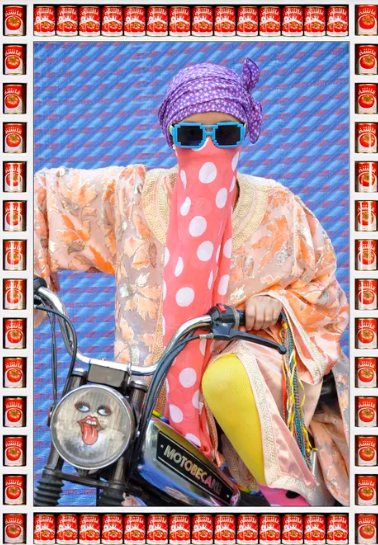
The exhibition brings together a selection of the artist's most iconic works: vibrant, playful portraits framed with plastic mats, motorbike tires, and everyday consumer goods, such as harissa cans. His subjects—depicting everyday scenes such as a veiled woman on a motorbike or a street acrobat—are captured in dynamic poses, dressed in garments designed by the artist himself, merging traditional Moroccan elements with contemporary streetwear influences. Through these compositions, Hajjaj constructs a visual language that is at once celebratory and subversive, challenging stereotypical representations while embracing popular culture and artisanal practices.
193 Gallery
24 rue Béranger
75003 Paris
The exhibition takes its name from the Hijri (Islamic) calendar. The year 1447 corresponds to the current year in the Hijri calendar, which follows lunar cycles and begins in 622 CE with the Hijra—the migration of the Prophet Muhammad from Mecca to Medina. This dual temporal framework is central to Hajjaj's practice: each of his works is dated according to both the Hijri and Gregorian calendars, reflecting the artist's navigation between cultural contexts and temporalities.
The exhibition brings together a selection of the artist's most iconic works: vibrant, playful portraits framed with plastic mats, motorbike tires, and everyday consumer goods, such as harissa cans. His subjects—depicting everyday scenes such as a veiled woman on a motorbike or a street acrobat—are captured in dynamic poses, dressed in garments designed by the artist himself, merging traditional Moroccan elements with contemporary streetwear influences. Through these compositions, Hajjaj constructs a visual language that is at once celebratory and subversive, challenging stereotypical representations while embracing popular culture and artisanal practices.