

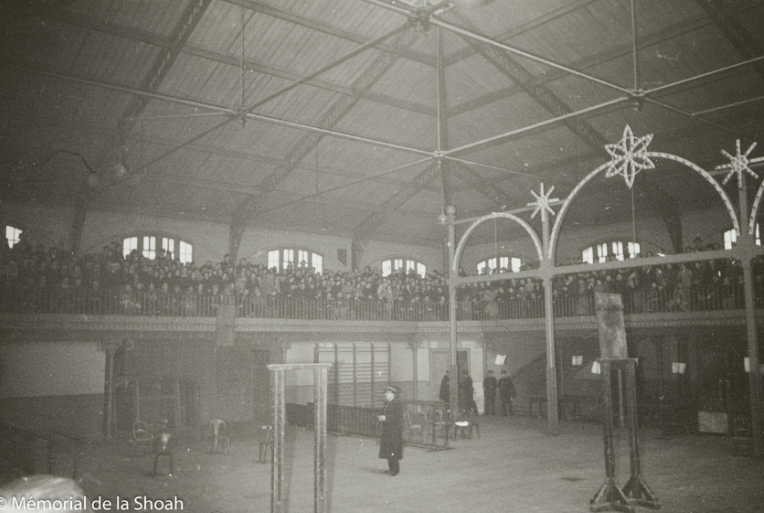
Gymnase Japy: the arrested men are parked in the bleachers upstairs. We discover for the first time the interior of Japy and the hundreds of Jewish men © Shoah Memorial
TITLE_NAME :
Exhibition Images of the "billet vert" roundup. An exceptional discovery for History
10/05/2026 - 31/12/2026
Mémorial de la Shoah
17, rue Geoffroy l'Asnier
75004 Paris
www.memorialdelashoah.org/
Shoah Memorial, September 2020. Two collectors present themselves at the photo library with five photographic contact sheets laminated on large cardboard sheets. Of these photographs, only ten are already known to specialists on the subject and have been published. They are marked with a cross on the original plates. The others are unpublished. This is the complete report.
An exceptional set of 98 images comes back to light, 80 years after the fact. This report documents the first mass arrest of Jews in France, the raid of 14 May 1941 called "billet vert", ordered by the occupier and organized by the French authorities.
Today, an exhibition and a book offer the public to participate in the investigation that has made it possible to find the identity of the photographer, Harry Croner, and to understand his "look" on these tragic events, a look on which the German censorship was brought down, condemning these historical photographs to an oversight of more than 80 years.
10/05/2026 - 31/12/2026
Mémorial de la Shoah
17, rue Geoffroy l'Asnier
75004 Paris
www.memorialdelashoah.org/
Shoah Memorial, September 2020. Two collectors present themselves at the photo library with five photographic contact sheets laminated on large cardboard sheets. Of these photographs, only ten are already known to specialists on the subject and have been published. They are marked with a cross on the original plates. The others are unpublished. This is the complete report.
An exceptional set of 98 images comes back to light, 80 years after the fact. This report documents the first mass arrest of Jews in France, the raid of 14 May 1941 called "billet vert", ordered by the occupier and organized by the French authorities.
Today, an exhibition and a book offer the public to participate in the investigation that has made it possible to find the identity of the photographer, Harry Croner, and to understand his "look" on these tragic events, a look on which the German censorship was brought down, condemning these historical photographs to an oversight of more than 80 years.