

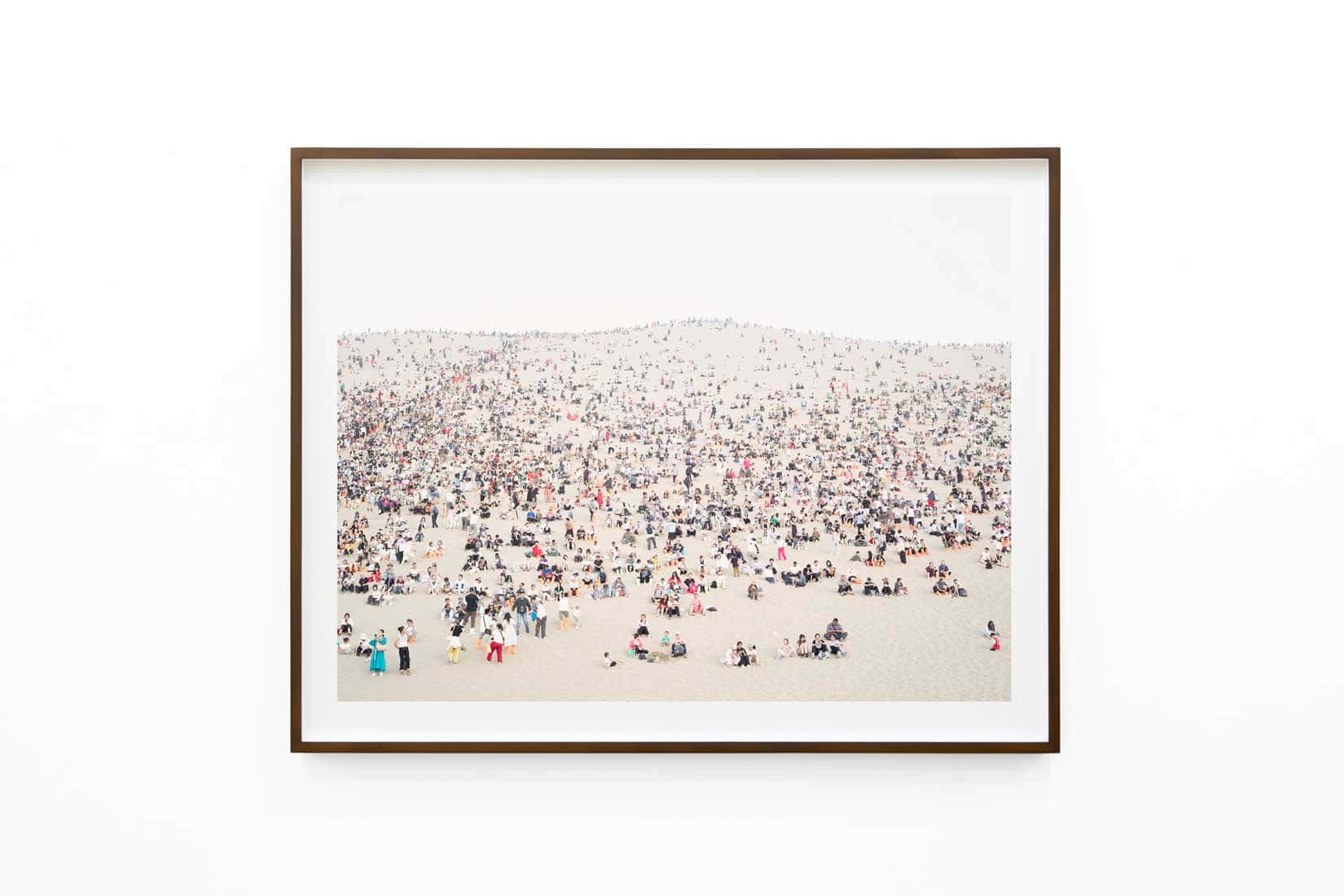
Zhang Kechun. People Singing in the Desert, The Yellow Desert, (2025) - Courtesy of the artist and Huxley-Parlour.
TITLE_NAME :
The Yellow Desert
30/01/2026 - 28/02/2026
Huxley-Parlour
3-5 Swallow Street
W1B 4DE London
www.huxleyparlour.com
Huxley-Parlour are pleased to announce The Yellow Desert, an exhibition of new works by photographer Zhang Kechun. The photographer's series, which began in August 2025, explores the desolate sands of the Gobi Desert and the rich, complicated history of Northern China.
Venturing far into the dunes and among the mountains of Northern China and Southern Mongolia, remnants of bygone human activity can be found scattered on and below the desert sands. Kechun sees in this landscape a condensation and inversion of time and space, juxtaposing sublimity with artifice, history with contemporaneity, and desolation with life. The Gobi Desert, which has become a popular tourist destination, possesses an intrinsic surreality through its haphazardly dispersed reconstructions of ancient religious sites which were once film sets, the remains of abandoned towns and oil extraction plants, and graves as old as the Han Dynasty under the feet of holiday makers. Kechun augments this surreality: restricted palettes of mostly yellows and compositions that isolate landmarks accentuate the vastness of the desert and the strangeness of the abandoned human products it contains. At other times, the photographer turns his lens onto swathes of tourists punctuating the dunes and admiring the relics of forgotten enterprise and human life.
30/01/2026 - 28/02/2026
Huxley-Parlour
3-5 Swallow Street
W1B 4DE London
www.huxleyparlour.com
Huxley-Parlour are pleased to announce The Yellow Desert, an exhibition of new works by photographer Zhang Kechun. The photographer's series, which began in August 2025, explores the desolate sands of the Gobi Desert and the rich, complicated history of Northern China.
Venturing far into the dunes and among the mountains of Northern China and Southern Mongolia, remnants of bygone human activity can be found scattered on and below the desert sands. Kechun sees in this landscape a condensation and inversion of time and space, juxtaposing sublimity with artifice, history with contemporaneity, and desolation with life. The Gobi Desert, which has become a popular tourist destination, possesses an intrinsic surreality through its haphazardly dispersed reconstructions of ancient religious sites which were once film sets, the remains of abandoned towns and oil extraction plants, and graves as old as the Han Dynasty under the feet of holiday makers. Kechun augments this surreality: restricted palettes of mostly yellows and compositions that isolate landmarks accentuate the vastness of the desert and the strangeness of the abandoned human products it contains. At other times, the photographer turns his lens onto swathes of tourists punctuating the dunes and admiring the relics of forgotten enterprise and human life.