

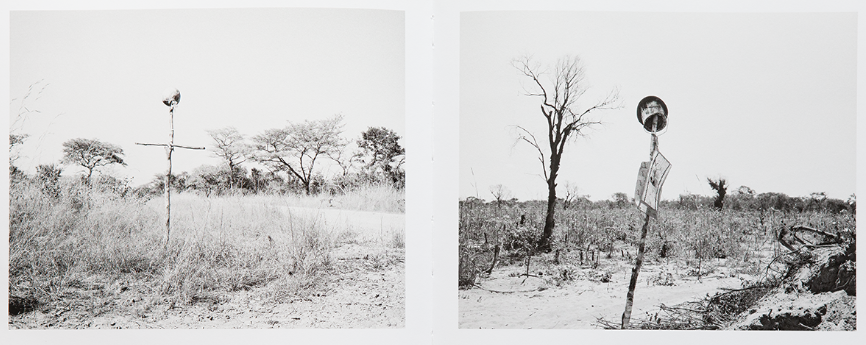
Images of "Out of Place" book by Atelier EXB. Images courtesy of Jo Ractliffe.
TITLE_NAME :
Out of Place
30/01/2026 - 24/05/2026
Atelier EXB
3, rue de Nancy
75010 Paris
https://exb.fr/en/
Photographer Jo Ractliffe is interested in "post-conflict" landscapes, particularly in southern Africa, as places of memory marked by the violence of war, even in their soil and ruins. Her photographs, mostly in black and white, reveal the traces and absences left by apartheid, regional conflicts, and population displacement. Ractliffe's work unfolds in this tension between visibility and invisibility, between intimate memory and collective narrative carried by landscapes that become domestic spaces and geopolitical territories. Her photographs—roads, vacant lots, urban peripheries—bring to light places where history surfaces without ever fully revealing itself. Through sober and poetic images, the artist captures the lingering effects of violence and historical trauma: by considering silences as witnesses to violence, she moves away from social documentary and focuses less on the event itself than on its "aftermath," questioning the way in which landscapes become archives.
30/01/2026 - 24/05/2026
Atelier EXB
3, rue de Nancy
75010 Paris
https://exb.fr/en/
Photographer Jo Ractliffe is interested in "post-conflict" landscapes, particularly in southern Africa, as places of memory marked by the violence of war, even in their soil and ruins. Her photographs, mostly in black and white, reveal the traces and absences left by apartheid, regional conflicts, and population displacement. Ractliffe's work unfolds in this tension between visibility and invisibility, between intimate memory and collective narrative carried by landscapes that become domestic spaces and geopolitical territories. Her photographs—roads, vacant lots, urban peripheries—bring to light places where history surfaces without ever fully revealing itself. Through sober and poetic images, the artist captures the lingering effects of violence and historical trauma: by considering silences as witnesses to violence, she moves away from social documentary and focuses less on the event itself than on its "aftermath," questioning the way in which landscapes become archives.